
(This article is an informational and personal experience article only. If you have any symptoms or questions related to your health, talk to your neurologist, nurse, or local doctor first. This post contains affiliate links. As an Amazon Associate, I earn from qualified purchases.)
If you’ve ever sat in a waiting room right before your neurologist walks in and felt your whole body tense up before a single word gets said, you already know exactly what this post is about.
(This is an informational and personal experience article only, talk to your neurologist, therapist, or local doctor for anything specific to your own diagnosis.)
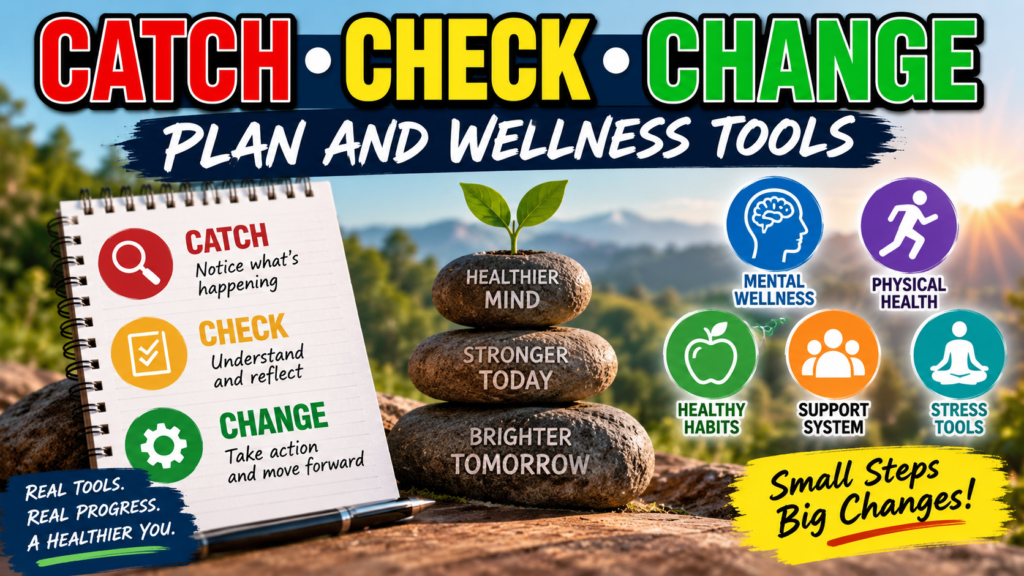
Mental health tools don’t have to be complicated to work. One of the ones I use the most, both for myself and with the people I work with, is called Catch It, Check It, Change It. It’s simple enough to use in the middle of a stressful moment, and it works whether you’re dealing with actual diagnosed depression or anxiety, the anxiety and depression that so often rides along with epilepsy, or just a rough situation, an interview, a doctor’s appointment, meeting new people, where you feel that familiar tightness show up.
What Catch It, Check It, Change It Actually Is
It’s a three step wellness tool. That’s really it. No worksheets, no app required, nothing you have to carry with you except your own attention. You catch what’s happening, you check why it’s happening, and then you change it. Let’s go through each one.
Step One: Catch It
This step is exactly what it sounds like. You notice something’s off. The anxiety is building. The depression is sitting heavier than usual. Something doesn’t feel right in the moment, and instead of pushing through it or ignoring it, you catch it.
That’s the whole first step, just naming that something is happening, right when it’s happening.
Step Two: Check It
Once you’ve caught it, you check it. This is where you sit with the situation for a second, out loud if that helps you, or just in your own head and ask yourself: why am I feeling this way? What’s actually causing this?
Most people can feel the anxiety or the heaviness before they can name where it’s coming from. You feel it first, and only figure out the “why” after. That’s normal. The check-it step is just slowing down long enough to actually ask the question instead of staying stuck in the feeling.
And here’s the part that surprises people: once you actually sit down and ask, the reason is usually easier to find than you’d expect. It’s often something simple. Doesn’t mean it isn’t real or valid, simple causes can still hit hard, but naming it tends to take some of its weight off.
Step Three: Change It
This is where you bring in a wellness tool to actually shift the situation. And I want to be careful with that word, because it matters.
A wellness tool is not the same thing as a coping skill. A coping skill can be anything you reach for to get through a hard moment, including things that aren’t good for you. Having a drink because you’re depressed is a coping skill. It’s not a wellness tool. A wellness tool is a positive action, like going for a walk, calling someone, going to a meeting, using an object that calms your mind. There’s no fixed list of what counts. If it helps you and it doesn’t hurt you, it qualifies.
Some real examples I’ve seen work, and use myself:
- A small object to hold or fidget with a stress ball, a smooth stone, anything tactile, especially helpful if you also deal with ADHD alongside epilepsy
- Something to read a blog post, a page in a book, even one paragraph, just enough to redirect your mind for a minute
- An object you simply hold, not even for fidgeting, some people carry a small pillow or item that’s just grounding to have in hand
- Physical exercise, which has its own real, researched effect on anxiety and depression ([more on that in this post]
If your anxiety shows up in the same kind of situation over and over, say, every time you’re at a doctor’s appointment, that’s exactly when a wellness tool earns its place. Bring the object. Use it before the doctor even walks in. Give your mind something steady to hold onto.
Action tip: if you know a specific situation reliably triggers your anxiety, appointments, interviews, group settings, pick your wellness tool before you’re in it, not during. Decide ahead of time what you’re bringing.
Sometimes “Change It” Means Stepping Away
Using a wellness tool isn’t the only version of changing the situation. Sometimes the honest answer is that you need to leave, or at least step back for a minute. If you’re at a doctor’s appointment, you may need to work through it, that’s a moment where a wellness tool really helps. But if you’re at a gathering with friends and you’re meeting new people, you don’t have to power through the whole thing. You can step outside for a minute. You can create a little space for yourself without leaving entirely.
Both are valid. Carrying all that stress through an entire event without any release isn’t sustainable, and it can build into something worse. Know yourself well enough to know which version of “change it” you need in the moment.
Why This Matters More When You Have Epilepsy
Epilepsy already asks a lot of your nervous system. Add anxiety about an upcoming appointment, or depression from the unpredictability of living with a seizure disorder, and it compounds fast. Catch It, Check It, Change It gives you a way to interrupt that pattern in real time, instead of just absorbing it and hoping it passes.
It’s not a replacement for treatment or for working with a professional, it’s a tool you can use in the moment, in the waiting room, before the appointment starts, in the car beforehand. That’s the whole point of a wellness tool: it has to be usable exactly when you need it.
Common Questions About Catch It, Check It, Change It
Is Catch It, Check It, Change It a clinical technique? It’s a straightforward, self-guided wellness tool grounded in noticing, naming, and responding to a feeling in the moment. It’s not a substitute for therapy or medical care, but it’s something you can use alongside those, especially in situations that reliably trigger stress.
What’s the difference between a wellness tool and a coping skill? A coping skill is anything you use to get through a hard moment, including things that aren’t good for you long-term. A wellness tool is specifically a positive action, something that helps without a downside, like a calming object, exercise, or reading something grounding.
Can this help with epilepsy-specific stress, not just general anxiety? Yes. The tool works for any situation that reliably triggers stress, and doctor’s appointments, EEGs, and the general unpredictability of living with epilepsy are exactly the kind of recurring situations it’s built for.
Try It Yourself
Next time you notice that familiar tightness before an appointment, or a wave of heaviness that doesn’t have an obvious cause, catch it. Check it. Change it. Start simple. It doesn’t need to be dramatic to work.
If you have a wellness tool of your own that gets you through moments like this, I’d genuinely like to hear it, drop it in the comments. And if you want more tools like this one, along with the mental health situations that come up most for people living with epilepsy, join the You’re Not Alone email list https://youre-not-alone.kit.com/90a8eb69ee . We go over common wellness tools, share helpful videos and talks, and work through this stuff together.
(This is an informational and personal experience article only, it’s always best to talk to your neurologist, therapist, or local doctor about anything specific to your own diagnosis.)
(This article is an informational and personal experience article only. If you have any symptoms or questions related to your health, talk to your neurologist, nurse, or local doctor first. This post contains affiliate links. As an Amazon Associate, I earn from qualified purchases.)